February 3, 2026
Navigating the Cities of the Future
Here's the uncomfortable question nobody's asking: if AI learns from the same poisoned data that broke traditional platforms, how does making recommendations faster solve the trust problem?
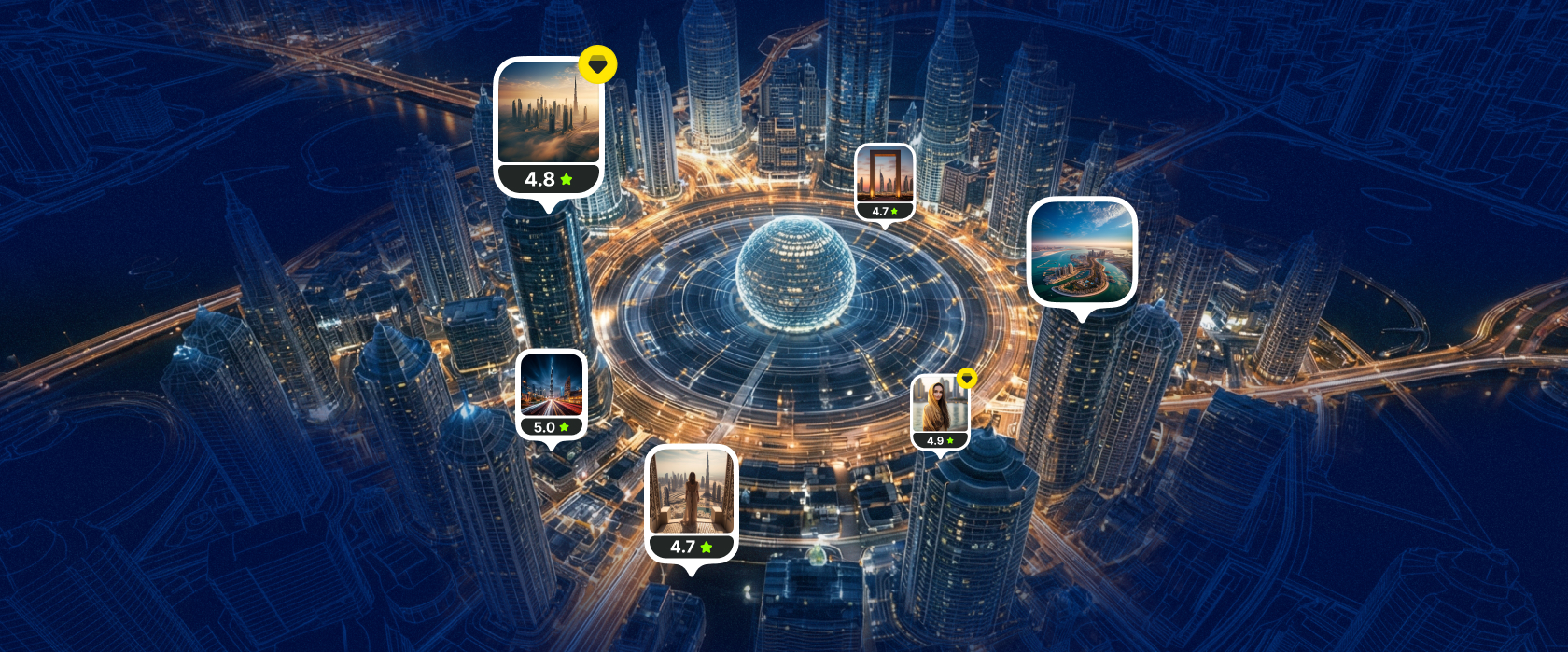
How AI Will Discover What Algorithms Cannot Verify
The vision is seductive: you arrive in Tokyo, and your AI travel companion instantly knows the perfect ramen shop for your taste preferences, the ideal time to visit Senso-ji Temple based on real-time crowd data, and the hidden jazz bar that matches your Spotify history. You do zero research, have no uncertainty or disappointing experiences based on fake reviews, since an algorithmic perfection guides you through the city.
But here's the uncomfortable question nobody's asking: if AI learns from the same poisoned data that broke traditional platforms, how does making recommendations faster solve the trust problem?
This is exactly why the daGama team is building something fundamentally different, going beyond another recommendation engine, and establishing a verification infrastructure layer that makes AI recommendations actually trustworthy.
The Smart City Mirage
McKinsey estimates that smart city applications could improve quality of life metrics by 10-30% by 2030, with travel and tourism being among the sectors with the highest impact. Tech giants are racing to develop AI travel companions, such as Google's AI-powered travel planning and Microsoft's partnership with TripAdvisor on AI recommendations, as well as dozens of startups promising to "reinvent travel discovery through AI."
Smart cities will be built on impressive infrastructure, featuring real-time sensor networks, IoT-enabled public spaces, predictive analytics for crowd management, autonomous transport systems, and AI-powered recommendation engines that process millions of data points per second.
And the forecasts are exciting to say the least. According to Allied Market Research, the global smart city market will reach around 7 trillion by 2030, with significant investment in location intelligence and visitor experience optimization. Cities like Singapore, Barcelona, and Dubai are deploying comprehensive smart infrastructure designed to make urban navigation seamless.
But all of this assumes the underlying data is trustworthy. That's where the entire vision collapses—and where daGama's Proof of Presence protocol becomes essential infrastructure.
Modern AI travel companions learn from existing data, which is often catastrophically compromised. BrightLocal's 2024 research shows 87% of consumers don't trust online reviews as the fake review industry generates billions annually.
Now imagine training an AI travel companion on this data. You're teaching it to recognize patterns in a dataset where 16-25% of reviews are fraudulent, where business payments influence visibility, where timing manipulation pushes criticism out of view, and where AI-generated reviews already fool humans 56% of the time.
This is the problem daGama was built to solve at the infrastructure level. The AI doesn't have to guess whether someone was actually at a restaurant, as daGama's Multi-Layer Anti-Fraud System (MLAFS) combines blockchain verification with machine learning to create training data that AI can actually trust. The ML layer detects physically impossible patterns (checking into five restaurants across Bangkok in 30 minutes), while the blockchain layer ensures every data point comes from verified physical presence.
What daGama's Verification Infrastructure Enables
The currently existing AI travel tools exhibit systematic biases because they learn from corrupted data, recommending the same over-marketed destinations, suggesting the same tourist-optimized restaurants, and, as a result, reinforcing the patterns that created overtourism in the first place.
daGama's architecture changes this fundamentally:
Verified presence as ground truth. Every review in daGama connects to a cryptographic attestation proving the reviewer was physically present. AI trained on daGama data learns from real experiences, not manufactured ones.
Traditional platforms can't provide this certainty. TripAdvisor doesn't know if reviewers actually visited, and Google doesn't verify physical presence. Instagram location tags can be added from anywhere. daGama's blockchain architecture makes "was this person actually there?" a mathematically verifiable question, not a probabilistic guess.
Multi-level assurance for AI confidence scoring. daGama's PoP protocol offers three verification tiers—Light, Standard, and High Assurance. AI recommendation engines can weight suggestions based on verification strength.
A restaurant with 100 High Assurance check-ins (anchor-verified physical presence with challenge-response authentication) signals quality differently than one with 1,000 Light Assurance check-ins. The AI learns that High Assurance attestations correlate more strongly with genuine quality because they're exponentially harder to fake.
This creates recommendation confidence scores based on verification strength, not just review volume. Traditional platforms treat all reviews equally. daGama's tiered verification gives AI the context to assess data quality, not just data quantity.
Temporal verification that AI can trust. daGama's blockchain records create a permanent, auditable, time-stamped history. AI can see that verified visitors from six months ago rated something highly, but recent verified visitors show declining satisfaction. This pattern is invisible in traditional review data, where timestamps can be manipulated, and reviews can be quietly deleted.
The daGama app shows users this temporal data through trend indicators, but more importantly, it provides AI systems with reliable time-series data about how experiences change. An AI trained on daGama data can warn you that a restaurant's quality has declined recently, and prove it with verifiable check-in patterns.
Token economics that incentivize quality. daGama rewards users with $DGMA tokens for helpful and authentic contributions determined by community voting. This creates training data where quality correlates with reward, giving AI a clear signal about what "helpful" actually means.
Traditional platforms optimize for engagement (more reviews = more ad impressions), while daGama optimizes for usefulness (better reviews = more tokens). AI trained on daGama data learns to recognize genuinely helpful information because the economic model rewards it, not just volume or positivity.

The Death of Unverified Travel Content
AI will indeed replace travel guides, blogs, and TripAdvisor, but only when it has verified data to learn from. Without verification, AI just automates the fake review problem at scale.
Traditional travel guides exist because local knowledge is scarce. daGama makes local knowledge abundant and verifiable, so you don't need a guidebook author's curated recommendations when you can query verified check-in patterns from people who provably live in the neighborhoods you're visiting.
Travel blogs provide value through demonstrated, authentic experience. daGama's blockchain verification provides mathematical proof of it. Every check-in is a cryptographically verified "I was there" that no blog post can match for certainty.
TripAdvisor aggregates opinions to surface truth through volume. daGama aggregates verified attestations that prove physical presence. Quality through verification beats quantity through aggregation when the aggregated data is compromised.
The daGama app is already demonstrating this transition. Users increasingly filter for verified recommendations over review volume. The trust is fundamentally different: you're not trusting crowd wisdom or platform moderation, but you're trusting mathematics and cryptography.
This article is for informational purposes only and does not constitute financial, investment, or legal advice.
Experience Web3 utility in action. daGama uses blockchain verification to deliver travel recommendations you can actually trust—no crypto knowledge required. Download the app and see what happens when blockchain solves real problems. And, stay tuned for the next episode!