February 13, 2026
Exploring the Top Travel Trends of 2026
The travel industry is undergoing its biggest transformation in decades—and verified experiences, AI companions, and blockchain infrastructure are at the center of these changes.
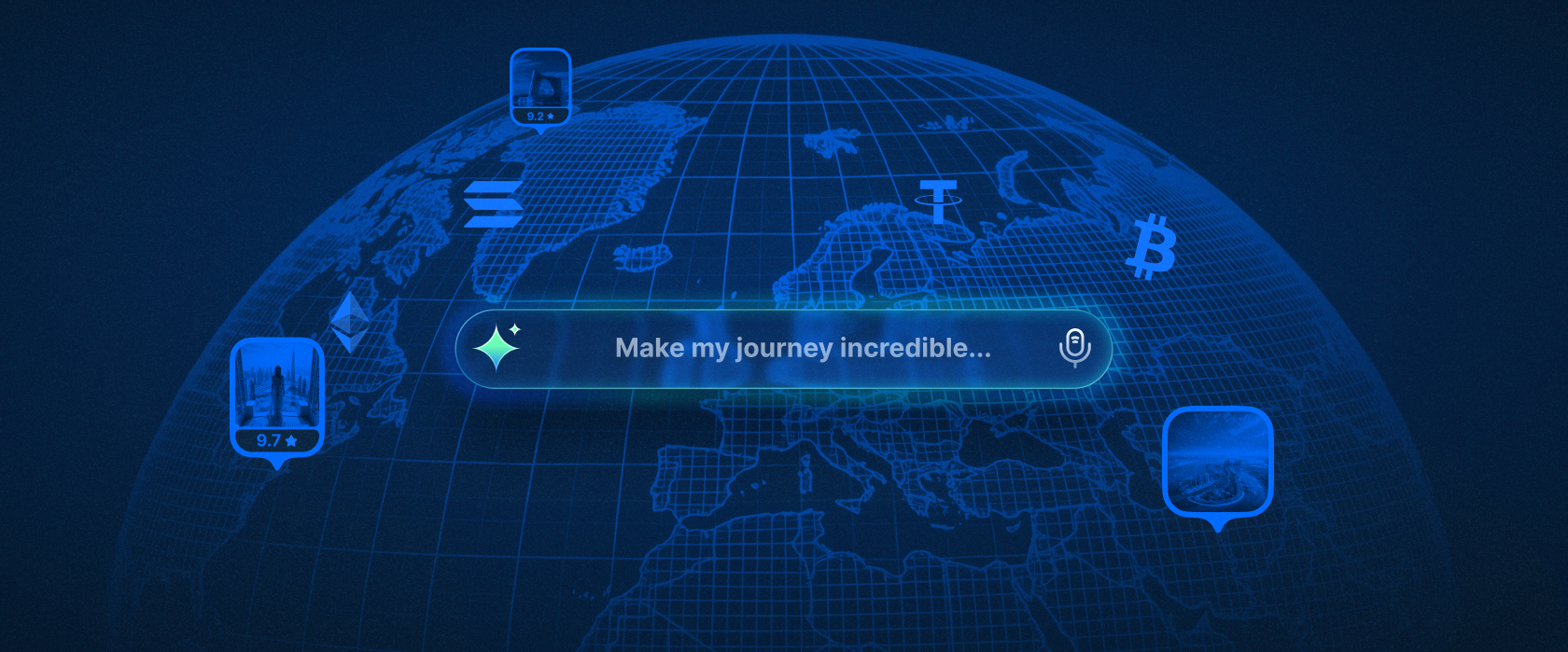

The travel industry is undergoing its biggest transformation in decades—and verified experiences, AI companions, and blockchain infrastructure are at the center of these changes.
We're a few weeks into 2026, and the travel landscape looks fundamentally different than even twelve months ago. The destinations and attractions haven't changed. However, the way people discover, book, experience, and share travel is experiencing drastic innovations. Let’s explore the main changes together!
The Winds of Change
During the last year, we've seen tectonic shifts driven by the technology maturity, changing traveler values, and the collapse of trust in traditional platforms.
Deloitte's 2026 Travel Outlook projects global travel spending will exceed $1.8 trillion this year, surpassing pre-pandemic levels by 23%. However, that growth isn't distributed evenly since it's concentrated in segments that embrace verification, authenticity, and technology-enabled discovery, while traditional mass tourism stagnates.
Moreover, Skift Research found that 67% of travelers now prioritize "verification of reviewer presence" over review volume when choosing restaurants and accommodations. This represents a complete inversion from 2023, when review quantity was the primary trust signal.
Let's examine the trends actually reshaping how millions of people travel, not the ones travel magazines wish were happening.
1. The Downfall of Unverified Recommendations
No, this isn't just a trend. Research agencies from all over the world see a foundational shift in how travelers make decisions. BrightLocal's latest research shows trust in online reviews has collapsed to historic lows, with only around 13% of travelers believing all reviews they read. However, here's what's changed in 2026: travelers aren't just skeptical as they are actively seeking verified alternatives and willing to pay for them.
The platforms gaining market share are those offering cryptographic verification of physical presence. What's emerging is a two-tier system: verified discovery platforms where presence is cryptographically proven, and legacy platforms where verification is impossible. Businesses with strong verified presence on platforms like daGama are seeing higher conversion rates compared to equivalent ratings on TripAdvisor.
2. AI Travel Companions Go Mainstream
AI travel planning crossed from early adopter curiosity to mainstream utility in late 2025, and 2026 will surely see mass adoption. McKinsey's AI adoption survey shows 41% of international travelers now use AI for trip planning, up from 12% in 2024. But there's a massive quality gap between AI trained on verified data versus AI trained on traditional review platforms.
Google's AI travel assistant, trained primarily on unverifiable Google Maps reviews and TripAdvisor data, consistently recommends tourist-trap restaurants with sophisticated review manipulation while missing authentic local favorites, and user satisfaction ratings experience constant decline.
Conversely, the systems made on the foundations of the verified presence data, like daGama's AI companion trained on blockchain attestations, achieve substantial user satisfaction scores because their recommendations are based on cryptographic proof, not probabilistic guessing about review authenticity. The difference is architectural. Traditional AI travel companions are hallucinating recommendations based on corrupted training data, while verified AI is discovering actual patterns in authentic human behavior proven through cryptography.
3. Stablecoin Payments Reach Critical Mass
Cryptocurrency payment adoption in travel accelerated dramatically in 2025-2026, but it's specifically stablecoin adoption, not Bitcoin or volatile cryptocurrencies, driving real usage. Chainalysis reports that stablecoin transaction volume for travel and tourism exceeded $47 billion in 2025, up 340% year-over-year. The driver?International travelers save 3-7% on every transaction by using stablecoins instead of credit cards, eliminating foreign transaction fees and currency conversion spreads.
Moreover, merchant acceptance reached a tipping point as major hotel chains, including Accor and Wyndham, now accept crypto through payment processors. Southeast Asian markets show particularly high adoption, with a higher number of tourist-facing businesses accepting stablecoins.
The surprise isn't that crypto-native travelers use stablecoins as mainstream travelers who've never touched crypto are adopting it specifically for travel. They're not interested in Bitcoin volatility or DeFi yields. These people just want cheaper, more reliable international payments.
4. Overtourism Redistribution Through Verified Discovery
The after pandemic overtourism period in 2020-2024 concentrated in the same dozen cities and attractions, creating unsustainable crowding while nearby areas saw minimal benefit. 2026 is seeing the first evidence of redistribution driven by verification infrastructure surfacing authentic alternatives.
UN Tourism data shows that while overall international arrivals increased 15% in 2025, traditional overtourism hotspots—such as Barcelona's Gothic Quarter, Venice's San Marco, Amsterdam's city center—actually saw arrivals decrease 8-12%. Meanwhile, secondary neighborhoods and lesser-known cities in the same regions saw increases of 30-50%.
The mechanism that can solve this is a verification-enabled discovery. AI trained on verified check-in patterns can surface excellent experiences in neighborhoods that traditional algorithms ignore because they lack SEO optimization and English-language reviews. A family-run restaurant in Barcelona's Gràcia neighborhood might have zero TripAdvisor presence but 50-100 verified local check-ins on daGama or similiar apps.
This creates economic redistribution that governments and tourism boards have tried and failed to engineer for decades. For examples, Thailand's Tourism Authority research shows that in 2024, 60% of tourism revenue concentrated in 5% of geographic areas. Early 2026 data shows this improving to 52% revenue in 8% of areas—still concentrated but distributing more broadly.
5. Micro-Communities Replace Influencers
Travel influencer marketing is declining sharply as travelers realize that influencer recommendations are rarely authentic: they're paid partnerships, gifted stays, or algorithm-gaming content designed for engagement rather than usefulness. Influencer Marketing Hub data shows engagement rates on travel influencer content dropped 31% in 2025, while sponsored post disclosure requirements made the commercial nature of recommendations more obvious.
What's replacing influencers areverified micro-communities of actual travelers with proven presence in specific regions or niches. Just image: such users with 200+ verified check-ins in Southeast Asia and consistent high community ratings have more influence than Instagram accounts with 500,000 followers and zero verification.
This creates new creator economics. Instead of needing millions of followers to monetize travel content, you need verified expertise in specific areas. A user with 500 verified restaurant check-ins in Tokyo, all highly rated by the community, could earns more $DGMA tokens and has more recommendation influence than someone with viral TikTok videos about Tokyo who's never actually been there! Isn't that encouraging enough?

6. Web3 Travel Loyalty Actually Works
For years, blockchain travel loyalty programs were vaporware. 2026 is finally seeing functional Web3 loyalty that delivers advantages traditional programs structurally can’t provide. The breakthrough is composability: traditional loyalty programs are designed as silosm since your Marriott points don't work at Hilton, and your airline miles transfer to hotels only through terrible conversion rates.
Meanwhile, Web3 loyalty tokens are composable by design. You earn them for verified contributions to the discovery ecosystem or even more! BCG research on loyalty programs estimates traditional programs devalue points by 5-8% annually through inflation and rule changes.
7. Proof of Presence Becomes Infrastructure
The biggest trend is often the most invisible: Proof of Presence (PoP) verification is becoming expected infrastructure rather than an innovative feature. In 2024, cryptographic verification of physical presence was a novel technology requiring explanation. Nowadays, travelers increasingly expect it and question platforms that don't provide it. "How do you verify reviewers were actually there?" has become a standard question when evaluating discovery platforms.
daGama's PoP protocol demonstrates what this infrastructure enables, withcheck-ins generate cryptographic attestations proving physical presence, multi-level assurance policies allow different verification strength for different use cases, on-chain permanence means verification records are auditable and immutable.
New travel platforms launching in 2026 onwards will have to include PoP verification as core architecture, not an optional add-on. Traditional platforms are scrambling to retrofit verification, though without blockchain infrastructure, they're limited to mere probabilistic trust rather than cryptographic proof.
8. Real World Locations as Asset Class
Perhaps the most significant trend is conceptual: Real World Locations are being recognized as a distinct asset class separate from traditional Real World Assets!
RWA in crypto typically means tokenizing financial assets—like real estate or commodity ownership. RWL means something different: verifiable reputation and authentic knowledge about physical places, minted as digital assets with economic value.
This shift is giving rise to new economic models, where discovery, reputation, and curation function as monetizable assets. Venture investment in real-world location (RWL) platforms accelerated sharply in 2025, growing several-fold compared with 2024.
What This Means for Travelers in 2026
These trends converge into a fundamentally different travel experience. You plan trips with AI trained on verified data, getting recommendations you can trust and pay with stablecoins, saving hundreds in fees. And you discover authentic local experiences that verification infrastructure surfaces, but traditional algorithms miss. As a result, you build a portable reputation across platforms through blockchain attestations.
The travelers winning this year are those who've adopted verification infrastructure, because verified experiences are measurably better than unverified alternatives.To sum this up, the biggest travel trend of 2026 isn't a destination or an aesthetic, but the transition from trusting unverifiable claims to demanding cryptographic proof.
Experience 2026's travel trends firsthand. Download daGama for verified AI discovery, stablecoin payments, and blockchain-based reputation building.
Download on App Store | Get it on Google Play | Explore the Future