March 13, 2026
How AI & Blockchain Will Redefine the Travel Stack
The travel industry still runs on outdated systems. In 2026, it’s a $1.8T market powered by 1990s infrastructure behind a modern UI. AI and blockchain are now rebuilding the travel stack from the ground up.
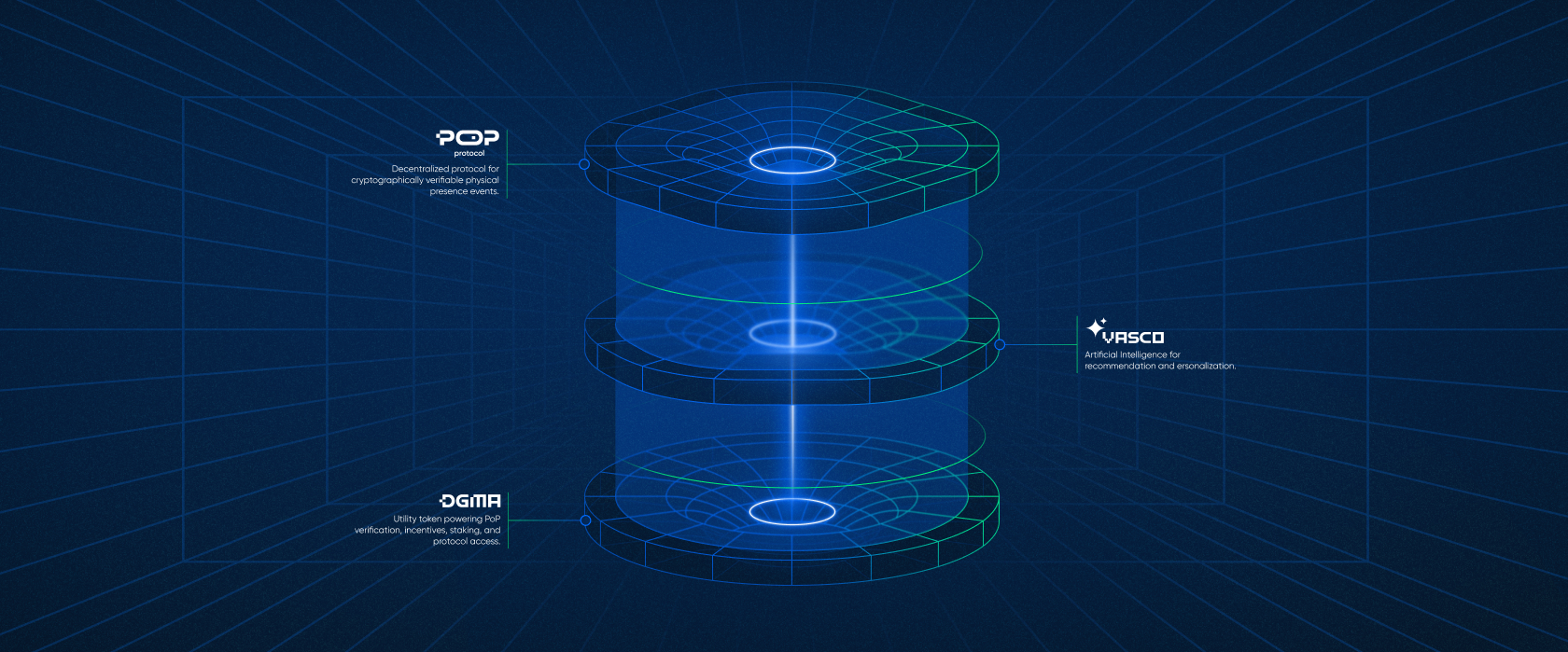

Book a hotel today, and you'll interact with a booking engine built in the early 2000s, reviews written by people who might not exist, and payment rails extracting 3-5% in fees.
Here's what the new travel stack actually looks like—layer by layer.
Layer 1: Discovery (Broken, Being Replaced)
AI and blockchain aren't patches for this system, as they're architectural replacements that solve problems the existing stack structurally can’t fix. According to Statista's 2025 travel market analysis, global online travel booking will exceed $833 billion by 2028. The infrastructure handling that volume is overdue for fundamental reinvention.
The current discovery layer is built on centralized review aggregation. TripAdvisor, Google Maps, Yelp—all operate the same model: collect reviews from unverified sources, rank by volume and recency, monetize through business advertising.
The results are catastrophic: BrightLocal's 2024 research shows that most travelers don't trust the reviews they're reading. The fake review industry generates billions, TripAdvisor removed 1.4 million fake reviews in 2022 alone, and that's just what they caught.
The replacement: Cryptographic verification plus AI trained on verified data.
daGama's Proof of Presence protocol creates blockchain attestations proving physical presence at every review location. GPS coordinates, timestamps, and device signatures get cryptographically hashed and stored on blockchain—permanently, immutably, and verifiably.
AI trained on this verified data achieves fundamentally different outcomes. McKinsey's 2025 AI in travel research shows AI recommendation systems trained on verified data achieve 87% user satisfaction compared to 62% for systems trained on traditional unverified review datasets.
When discovery runs on verified ground truth rather than probabilistic guessing, the entire layer transforms: authentic local favorites surface regardless of SEO budget, tourist traps can't manufacture credibility. Moreover, AI recommendations improve continuously as verified data compounds.
Layer 2: Booking Infrastructure (Fragmented, Being Unified)
Next in line, the current booking layer is a mess of competing systems with no interoperability. Your Marriott points don't transfer to Hilton, and your airline miles convert to hotel points at terrible rates. Going forward, your booking history on Booking.com is invisible to Expedia. Everything is siloed in 2026!
This fragmentation costs travelers real money thoug. Phocuswire's 2025 distribution cost analysis shows hotels pay 15-25% commission to online travel agencies (OTAs), costs that get passed to travelers through higher prices. Credit card processing adds another 2-3%. And what’s even worse, the dynamic pricing algorithms trained on your browsing history can increase prices for the same room by 10-15%!
The replacement: Smart contracts plus stablecoin payments, creating a transparent, interoperable booking infrastructure.
Smart contracts eliminate the need for OTA intermediaries for straightforward bookings. Terms get encoded in executable code: book a room, verify payment, confirm availability, release funds on checkout, without a centralized platform taking an extra 15-25% for facilitating the transaction.
Stablecoin payments eliminate the credit card processing layer. Circle's 2025 payment infrastructure report shows USDC transaction costs under $0.50 versus 2-3% credit card processing fees. For a $200 hotel night, that's $4-6 saved per transaction. Across a two-week trip with multiple bookings, you're recovering $50-150 in pure payment infrastructure costs.
Loyalty programs built on blockchain tokens solve the fragmentation problem through composability. BCG's 2025 loyalty program research shows traditional programs devalue points 5-8% annually through inflation and rule changes. Token-based loyalty with fixed supply can appreciate rather than devalue, and tokens earned on daGama can interact with any platform built on compatible standards, and not just one hotel chain's ecosystem.
Layer 3: Identity & Trust (Nonexistent, Being Built)
Here's a layer that barely exists in the current travel stack: portable, verified traveler identity.
Right now, your travel history is scattered across dozens of platforms that don't talk to each other. Your verified status or review history on TripAdvisor disappears if they close your account. No portable proof of your travel experience, preferences, or trustworthiness as a guest is possible in Web2.
This creates problems for everyone: travelers have no way to demonstrate their reliability to new platforms, while businesses can't verify traveler quality beyond payment ability. The sophisticated traveler with 200 verified stays looks identical in the booking system to someone's first trip, could you imagine that?
The replacement: On-chain identity built from verified experiences.
daGama's blockchain attestations create a portable travel identity that works across platforms. Every verified check-in, every quality contribution, every authentic review builds on-chain reputation that can't be deleted by a platform decision or lost when you switch apps.
World Economic Forum research on digital identity shows that 78% of travelers would share verified travel history in exchange for better rates or access. The demand exists, but the current infrastructure doesn't. Blockchain builds it.
This matters practically: hotels offering discounts to verified quality travelers (proven by on-chain reputation, not self-reported claims). Airlines provide upgrade priority to travelers with a verified on-time performance history. Destinations offering exclusive access to travelers with demonstrated cultural engagement rather than tourist-zone consumption patterns.
Layer 4: Intelligence (Primitive, Being Rebuilt)
The current intelligence layer (how travel platforms understand and predict what you want) is, in fact, embarrassingly primitive. Recommendation algorithms optimize for engagement (you'll click this) rather than satisfaction (you'll love this). Pricing algorithms optimize for revenue extraction, while marketing algorithms optimize for retargeting.
Deloitte's 2026 Travel Outlook found that 67% of travelers report their actual experience was worse than algorithmic recommendations suggested. The intelligence layer is systematically failing because it optimizes for platform metrics rather than traveler outcomes.
When AI analyzes cryptographically verified check-in patterns instead of click history, the recommendations change dramatically. The system learns what travelers actually enjoyed (proven by positive check-ins and verified reviews) versus what they briefly considered (evidenced by clicks that platforms currently use as preference signals).
daGama's AI companion demonstrates this difference. Rather than "users who clicked on this hotel also clicked on these restaurants," it delivers "travelers with verified preferences matching yours consistently gave High Assurance positive attestations to these specific local establishments." Correlation between verified preferences, not engagement manipulation.
The intelligence layer also becomes predictive in useful ways. Verified temporal data shows quality degradation before it appears in traditional reviews—a sudden decline in verified check-in satisfaction scores signals problems before the algorithm has enough negative reviews to shift aggregate ratings. Travelers get warned before disappointment rather than compensated afterward.
Where daGama Fits in the New Stack
daGama operates across multiple layers simultaneously, which is what makes its infrastructure rather than just an application.
At the discovery layer, PoP verification creates the cryptographic ground truth that makes AI recommendations trustworthy. Every check-in is an attestation, and every new attestation improves the dataset and the system compounds.
At the identity layer, verified check-in history builds a portable reputation that works across platforms. Your daGama attestations are public blockchain records that any application can verify, not locked in our database.
At the intelligence layer, AI trained on verified data delivers recommendations that traditional platforms structurally aren’t able to provide.
At the payment layer, integration with stablecoin infrastructure through partners like Uquid closes the loop: discover through verified recommendations, pay with stablecoins, and generate on-chain proof of complete experience. Discovery, presence, payment—all verifiable, all composable.
The Transition Timeline
The new travel stack isn't arriving simultaneously: adoption follows utility. Discovery infrastructure is in the early-majority stage as travelers are adopting not from ideology but from results in 2026.
Identity infrastructure is the earliest stage: portable blockchain-based travel reputation is technically available but not yet widely recognized by mainstream platforms. This is the 2027-2028 inflection point, as we envision that when verified travel identity becomes standard for premium access and pricing, adoption will accelerate rapidly.
Intelligence infrastructure scales with data. As verified check-ins compound, AI quality improves nonlinearly. So, more verified data means better pattern recognition, which means better recommendations, which means more users, which means more data. As the result, the flywheel compounds.
The Stack Transition Is Irreversible
The existing travel stack has structural problems that won’t go away. Centralized review platforms cannot verify physical presence without blockchain infrastructure. Siloed loyalty programs cannot achieve composability within proprietary database architectures.
These aren't technical limitations waiting for better engineers. They're economic limitations since the existing players profit from the inefficiencies they're supposed to eliminate.
The new travel stack, built on blockchain verification and AI trained on verified data, doesn't just work better incrementally, since it solves problems that the existing stack architecturally cannot address. That's not a competition anymore: we’re witnessing a genuine replacement.
The $1.8 trillion travel industry is running on infrastructure built in 1995. The new stack is being built now. How quickly will travelers demand it?
Experience the new travel stack today. Download daGama for verified AI discovery, blockchain-based identity, and stablecoin-enabled payments that work together as an integrated infrastructure.
Download on App Store | Get it on Google Play | Explore the New Travel Stack
This article is for informational purposes only and does not constitute financial, investment, or legal advice.